Generative AI for cardiologists
A full introduction to Large Language Models for cardiologists and residents. Not a marketing story, how they work, what you can do with them in the clinic, and why you are the safety layer.
The course follows the same structure as ChatGPT for beginners: short explanation → 2–3 multiple choice questions → a live exercise in ChatGPT or Claude. You can return to this start page at any time.
The technology is already inside our hospitals, knowledge about it is lagging. This course closes that gap.

Which genAI tools exist, and what do they cost?
Generative AI (“genAI”) is the umbrella term for chatbots that produce text, images and code. The best known: ChatGPT (OpenAI), Claude (Anthropic), Gemini (Google), Microsoft Copilot (built on OpenAI's models, inside M365), Mistral / Le Chat (France, EU) and DeepSeek (China). All of them have a free version, that's enough to do this entire course.
| Tier | Price (indication*) | What's the difference? |
|---|---|---|
| Free | €0 | The base model, with limits on the number of messages per day and often a smaller working memory. Fine for learning and one-off tasks. |
| Paid subscription (ChatGPT Plus, Claude Pro, Gemini Advanced) | ~€20–25 per month | Access to the newest and smartest models, much higher limits, a larger working memory and extra features such as Projects and file processing. You mainly notice this with daily use. |
| Top and organisation subscriptions (e.g. ChatGPT Pro, Claude Max, Microsoft 365 Copilot at organisation level) | €100–200+ per month; on a yearly basis this can run towards €2,000 per user | Near-unlimited use of the heaviest models, priority during peak times and, with organisation licences, enterprise data protection and IT administration. You don't need this for this course. |
* Prices and packages change regularly; check the current prices with the vendor itself.
Who makes these chatbots? Where they're based, and what you watch for as a doctor
In this course you'll mostly practise with ChatGPT and Claude. Other models appear too: Gemini (Google), Mistral (the French / EU player; relevant if your hospital is looking for a European supplier) and DeepSeek. This block is not a legal or privacy verdict: it helps you choose consciously what to paste where. Always consult the supplier's current privacy policy and your hospital's and scientific society's policies.
| Product | Which company? | Region of establishment | What you watch for as a doctor |
|---|---|---|---|
| ChatGPT | OpenAI | United States (US), San Francisco. | US jurisdiction; storage and training policy varies per product and subscription (free vs Plus vs Enterprise vs API with zero-data-retention). No patient data in the public chat without DPIA and approval from your organisation. |
| Claude | Anthropic | United States (US), San Francisco. | Anthropic publicly positions itself emphatically around AI ethics (e.g. AI safety, their self-chosen term Constitutional AI). That sometimes makes policy explicitly cautious, not carte blanche to share patient data freely. Separately verify that your use case fits within organisational and legal frameworks (DPIA, processor agreement, sub-processors). |
| Gemini | Google DeepMind | United States / global; Google has data centres in the EU (note the product line: Gemini app, Google AI Pro, Workspace, NotebookLM). | Deep integration with Google Workspace also means Gemini can read your Drive/Gmail/Docs, only activate if the organisation has configured it. EU rollout of Personal Intelligence lags due to data-residency legislation. |
| Mistral / Le Chat | Mistral AI | France (Paris), within the EU. EU-based hosting possible; several models are open-weights. | For healthcare institutions where data residency and GDPR compliance weigh heavily, often the first alternative next to Microsoft Azure-hosted GPT/Claude. EU jurisdiction is closer to NEN-7510, NVVC and NFU guidelines. At the same time: the clinical ecosystem is smaller, the medical literature on Mistral performance is thinner than for GPT/Claude, and “EU-based” ≠ automatic guarantee that all data and sub-processors stay in the EU, test this per product and subscription. |
| DeepSeek | DeepSeek (深度求索) | China (Hangzhou, Zhejiang). | Chinese regulatory and sovereignty context. For European healthcare data and certainly patient data, be extra alert to processor locations, legal framework and possible political/trade aspects. Same technical risks of hallucination and bias as with other models. |
Reflection question: suppose you want to present an anonymised endocarditis case to an LLM for differential consideration. Which two substantive questions would you ask ICT/CIO or the DPO of your hospital before you start typing, and which answer would you let be “red” in advance (so don't do it) regardless of the tool? And as a follow-up: does the EU argument for Mistral weigh more heavily for your department than the clinical maturity of ChatGPT or Claude, or the other way around?
The six modules
Each module begins with short, clinically-focused explanation, followed by multiple choice questions with feedback, and ends with a live exercise you can open directly in ChatGPT or Claude. No patient data, just realistic cardiology scenarios.
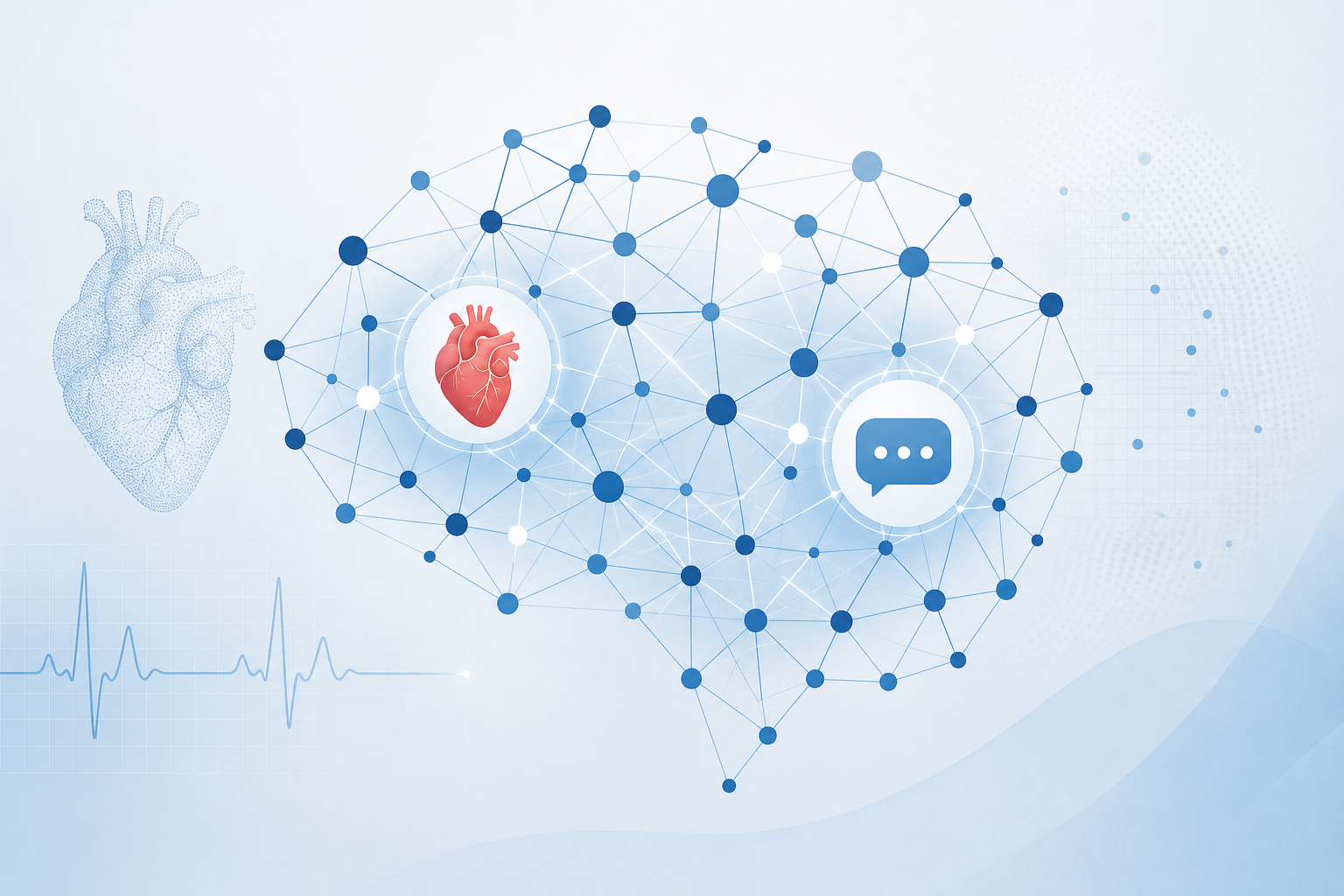
Module 1: What is an LLM?
The AI landscape, the core trick in one sentence (predicting the next token), tokens and embeddings, vectors as meaning, scale and emergent behaviour. With a tokenizer experiment to see it for yourself.
Start module 1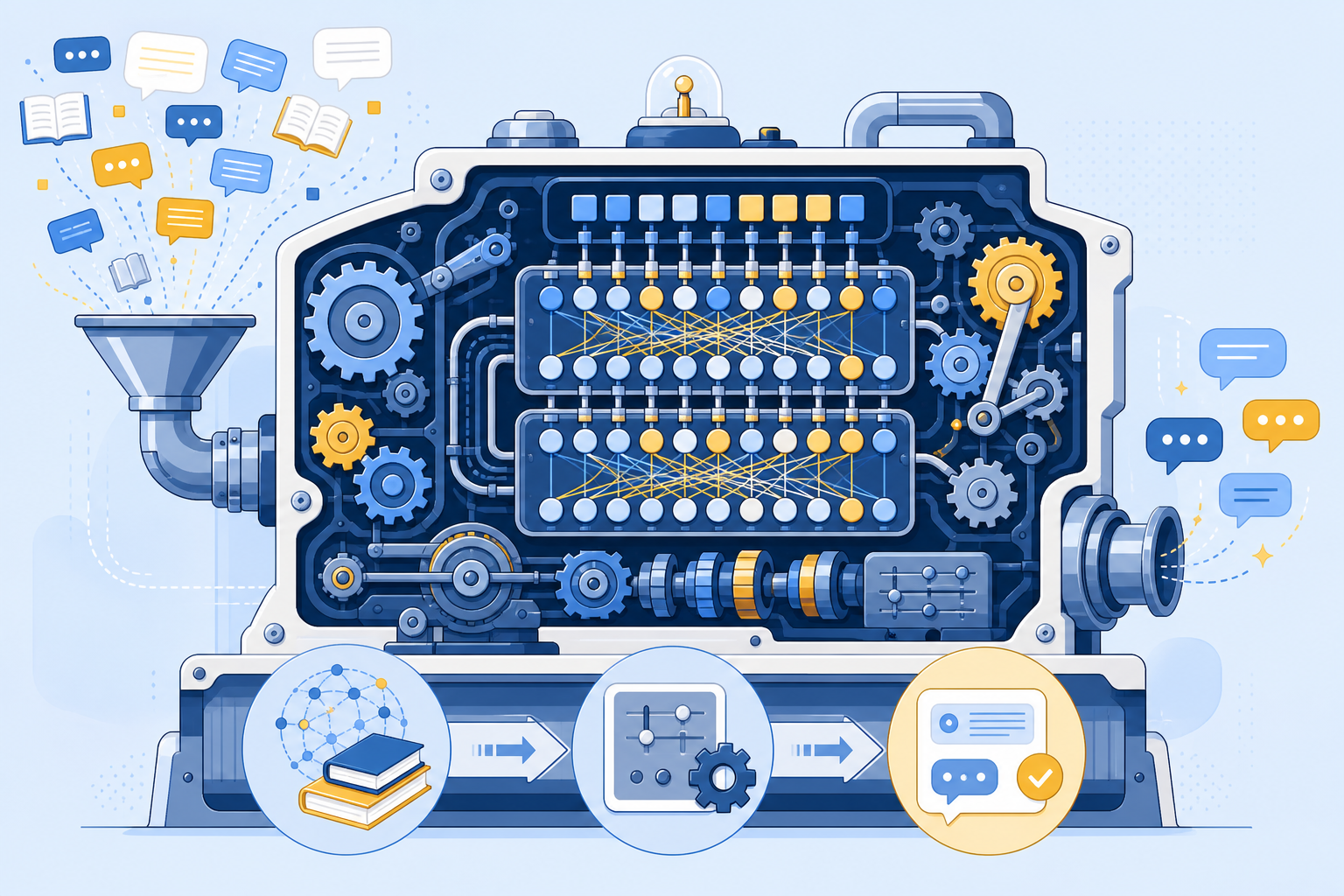
Module 2: How is it made?
Pre-training, supervised fine-tuning, RLHF/DPO, domain-FT (Med-PaLM, MedGemma) and RAG. The Transformer and attention. The context window, why you put your question at the bottom and what “lost in the middle” means for long guidelines.
Go to module 2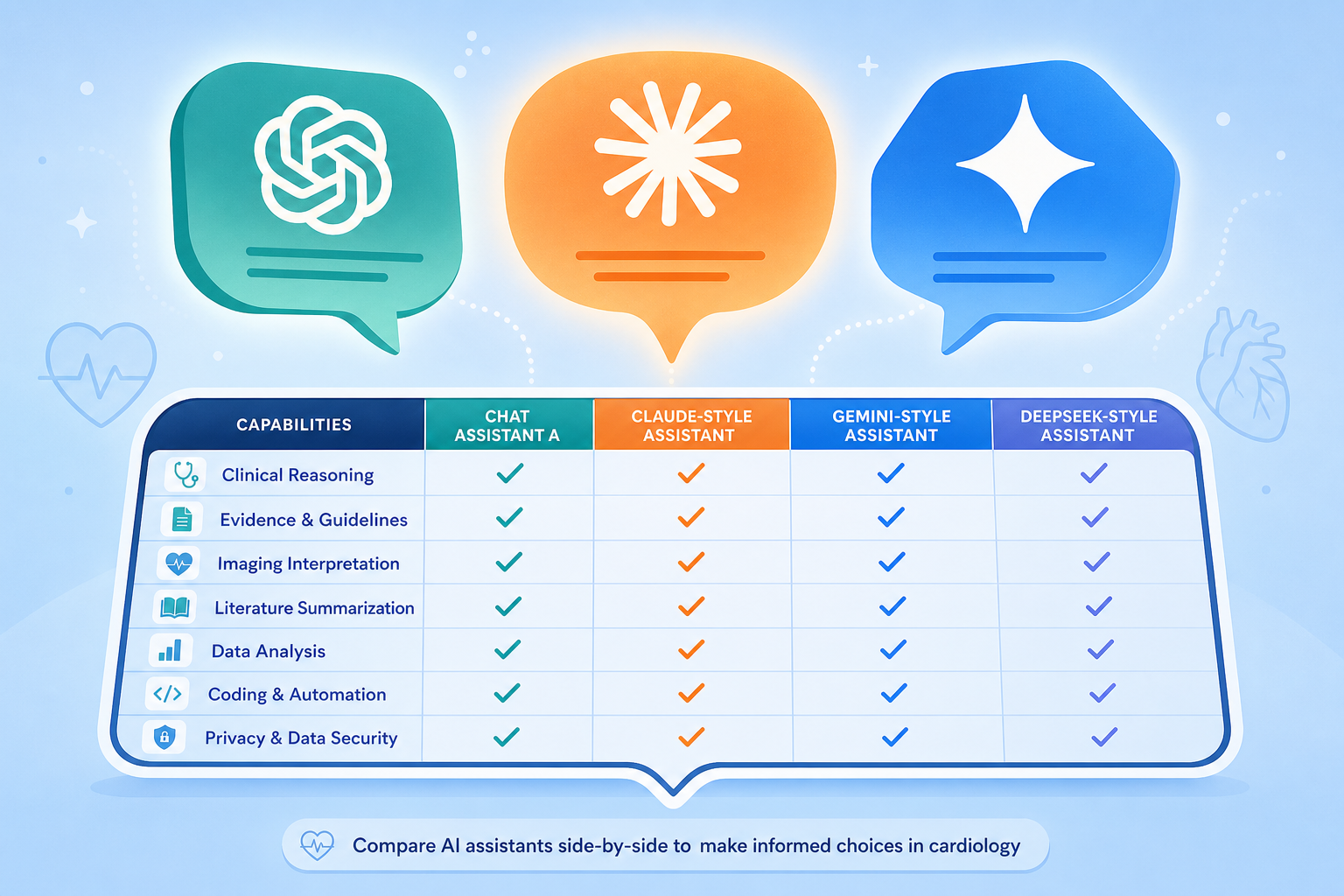
Module 3: The main players (ChatGPT, Claude, Gemini, Mistral, DeepSeek)
Per tool: what they do well, what they don't, and which to pick when for letters, guidelines, code, data or image. Mistral (Paris, EU) is treated separately as the data-residency route; DeepSeek (China) as a sovereignty case. Plus the exponential pace: what is “not quite” today is often usable 12 months from now.
Go to module 3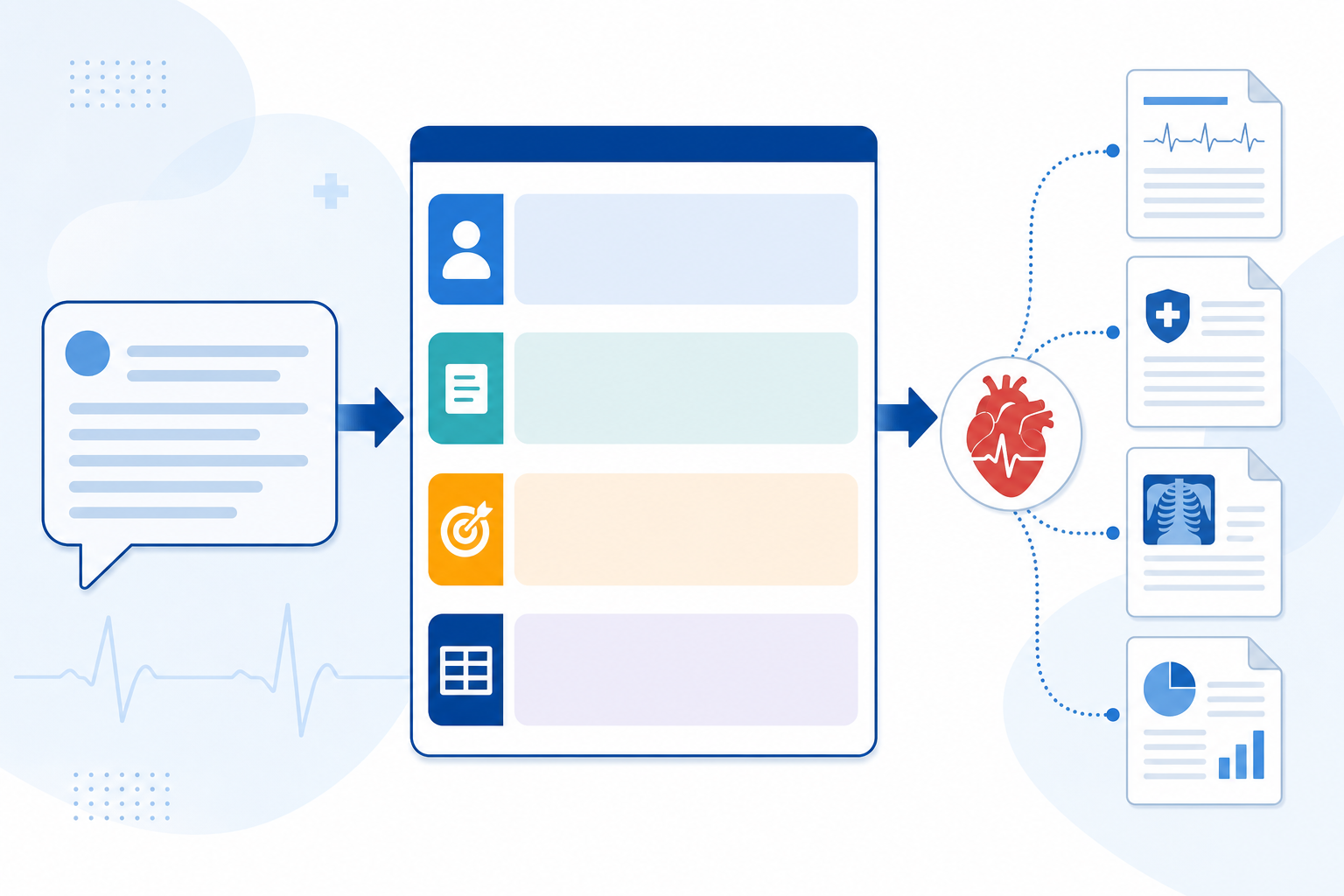
Module 4: Cardio prompt architecture
Role + context + task + format + uncertainty. Differential diagnosis for chest pain, editing a discharge letter, patient information at B1 reading level, summarising ECG and imaging findings, literature and guidelines. Five live exercises.
Go to module 4
Module 5: Risks and how to frame them
Hallucinations (why they're not a bug), GDPR and the traffic-light rule, bias in the model and in the user (automation bias), the four rules of thumb, and how to embed this locally (DPIA, governance, ESC AI Hub). Hallucination hunt as final exercise.
Open module 5
Module 6: The big case: cardiogenic shock after anterior wall infarction
Everything from modules 1–5 applied to one realistic case adapted for teaching (Impella, VA-ECMO, LVAD screening). Five LLM work assignments, summarising in three formats, DD sparring, fact-checking, treatment plan vs. guideline, prompt iteration & privacy, plus ten multiple-choice questions.
Open module 6Done with the modules?
Wrap up the course with a quick evaluation (2 min) or dive straight into the assignment book with 12 cardio exercises to practise on real cases.