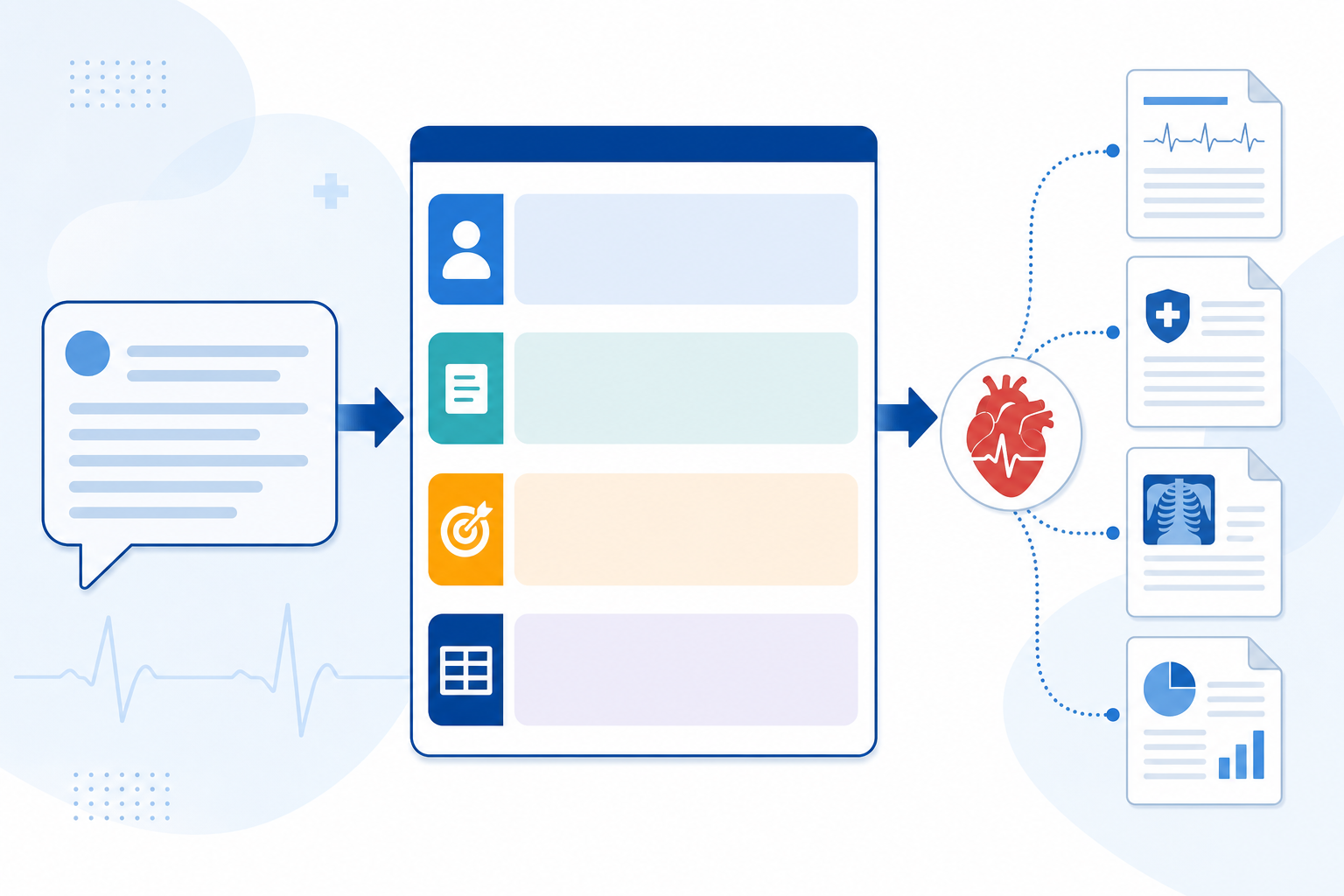
This is the practice module. You'll learn to build prompts according to the fixed formula role + context + task + format + uncertainty, and apply it to six typical cardio scenarios: differential diagnosis for chest pain, editing a discharge letter, patient information at B1 reading level, summarising ECG findings, providing imaging context, and creating teaching for residents.
What you'll learn: how a good clinical prompt is built, five live exercises (do each at least once), and which information you'd better not put in a prompt, regardless of the tool.
Lesson 4.1: The five building blocks of a clinical prompt
Goal: one checklist you mentally run through before every prompt.
The five building blocks
1. Role, who is the model playing? (“You are an experienced cardiologist with attention for differential diagnosis …”)
2. Context, what does it need to know? (anonymised case, relevant guideline, earlier consideration)
3. Task, what is the exact requested output? (“Give a top 5 DD with pro/con arguments per item.”)
4. Format, what does the answer look like? (list / table / letter / SBAR / length)
5. Uncertainty, let the model explicitly indicate what it does/doesn't know and what assumptions it makes.
The fifth step in particular is often skipped. Without it, the model defaults to a “know-it-all” tone. Adding one line, “name two assumptions you made and one point you're not sure about at the bottom”, often makes the entire answer much more usable, and puts you in verification mode in advance.
Questions for lesson 4.1
1. Why would you use the five building blocks, role, context, task, format, uncertainty?
2. What's the most important effect of adding “name two assumptions and one uncertainty”?
Lesson 4.2: Provide source, don't ask for source
The most important prompt rule to avoid hallucinated guideline citations.
From module 1 you know: an LLM doesn't “know” the guideline, it has memorised text patterns. As soon as you ask “what does the ESC guideline X say about Y?”, the model fills the form of a guideline citation with content that sounds statistically plausible. Sometimes it's right, sometimes not.
The rule
Want reliable guideline content? Paste the relevant chapter yourself into the prompt. Then the model works with your source, instead of its vague memory.
Two variants of the same question, see what the difference does:
❌ Form A, asking for source
What does the ESC 2023 endocarditis guideline say about the indication for PET-CT in prosthetic valve endocarditis?
✅ Form B, providing source
Below is chapter 5.3 of the ESC 2023 endocarditis guideline (copied from the original):
[paste here the exact text of the chapter]
Summarise in 5 bullets which modalities are recommended for diagnostics in prosthetic valve endocarditis, and in which clinical situation. Quote each time the exact sentence from the chapter you base it on. If something is not explicitly in the chapter, write “not stated in this fragment”.
Questions for lesson 4.2
3. What's the best prompt strategy to prevent hallucinating guideline citations?
Lesson 4.3: Differential diagnosis for chest pain
Goal: a DD prompt that structures instead of forcing conclusions.
What an LLM must not do: give a definitive clinical conclusion. What it can do well: generate a broad DD, order pro/con arguments, and help you not forget any category. Here's how it goes into a prompt:
Cardio DD template
Role: you are a cardiologist in the ED with attention for broad differential diagnosis.
Case (anonymised):
[paste here: age range, sex, brief history, complaint presentation, vital signs, brief ECG finding, brief lab. NO name, BSN or unique identifiers.]
Task: give a top 6 differential diagnosis, sorted from most to least likely in this presentation. Per item:
- Pro arguments (from the case)
- Con arguments (from the case)
- One additional investigation that can quickly confirm or exclude this diagnosis
Format: a table with 4 columns.
Uncertainty: at the bottom, name which 2 pieces of additional information would change the DD most, and which 1 possibility you deliberately left out and why.
Two deliberately built-in things:
An additional investigation per item. Forces the model from “naming diagnosis” to “how do you proceed?”. Usable in practice.
“Which information would change the DD most?” That's the question you'd also ask a good resident, and it keeps the conversation on “what don't we know” instead of “what's the answer”.
Live exercise 1: DD for chest pain
Paste the whole template into the chat and supplement the case with this anonymised data:
Role: you are a cardiologist in the ED with attention for broad differential diagnosis.
Case (anonymised):
Man, ca. 50 years old, ex-smoker, hypertension. Since 90 minutes retrosternal pressure radiating to left arm, no relief after 2x sublingual nitro. BP 145/90, HR 95, SpO2 96%. ECG: T-wave inversions V2–V5, no ST elevations. First hs-troponin slightly elevated above 99th percentile. Not diabetic, no family history of premature CV.
Task: give a top 6 differential diagnosis, sorted from most to least likely in this presentation. Per item:
- Pro arguments (from the case)
- Con arguments (from the case)
- One additional investigation that can quickly confirm or exclude this diagnosis
Format: a table with 4 columns.
Uncertainty: at the bottom, name which 2 pieces of additional information would change the DD most, and which 1 possibility you deliberately left out and why.
Points to consider when assessing: (1) is NSTEMI at the top with correct pro/con? (2) do aortic dissection, pulmonary embolism and pericarditis appear? (3) what does the model name as “what would change the DD most”, does that match what you'd want to know?
Lesson 4.4: Editing a discharge letter
Goal: have a letter's form and tone polished without shifting clinical content.
This is one of the high-frequency wins: turning a first draft or rough notes into a clean discharge letter for the GP. Important: your clinical outcomes, doses, follow-ups are in the prompt. The model rewrites form, not content.
Discharge letter template
Role: you are a cardiologist writing a short, professional discharge letter to the GP.
Below are my raw points / dictation (anonymised):
[paste here as bullets]
Make a clean discharge letter from this in this structure:
1. Brief greeting + reason for admission
2. Main findings (in 1 paragraph)
3. Diagnosis/diagnoses
4. Management in the hospital
5. Medication at discharge (bullets with dose/frequency)
6. What the GP must do (bullets)
7. Follow-up / outpatient appointment
Rules:
- Do NOT change doses, numbers or medication names that are in my dictation.
- Do NOT add clinical findings I did not mention.
- Keep it concise: maximum 350 words.
- Neutral, professional tone. No enthusiasm words.
- End with “Kind regards, <my name>” (leave <my name> literally, I'll fill it in later).
Four rules you must always include
Don't change doses, numbers, or medication names from your dictation.
Don't add clinical findings you didn't mention.
Fixed length (forces 'compression' instead of addition).
Fixed tone (otherwise you accidentally get “the patient is in fantastic health”).
Questions for lesson 4.4
4. Which rule keeps the model from “accidentally changing” doses as much as possible?
Live exercise 2: Discharge letter from raw points
Paste the template with these anonymised raw points:
Role: you are a cardiologist writing a short, professional discharge letter to the GP.
Below are my raw points / dictation (anonymised):
- Woman, ca. 70 years old
- Admission: heart failure decompensation in pre-known HFrEF, EF ca. 30%
- Reason for admission: dyspnoea class III, total weight +4 kg in 2 weeks
- Findings: pulmonary congestion, no leg oedema, lab Na slightly low, NT-proBNP markedly elevated
- IV furosemide 80-40-40 mg pump started, then oral furosemide 40 mg morning
- HFrEF therapy optimised: bisoprolol 5 mg, sacubitril/valsartan 49/51 BID, dapagliflozin 10 mg started
- MRA not resumed due to hyperkalaemia 5.4
- Echo repeated: EF 32%, no new wall motion abnormalities
- Diagnosis: decompensated HFrEF
- Outpatient follow-up 2 weeks
- GP: blood pressure + potassium + creatinine after 1 week
Make a clean discharge letter from this in this structure:
1. Brief greeting + reason for admission
2. Main findings (in 1 paragraph)
3. Diagnosis/diagnoses
4. Management in the hospital
5. Medication at discharge (bullets with dose/frequency)
6. What the GP must do (bullets)
7. Follow-up / outpatient appointment
Rules:
- Do NOT change doses, numbers or medication names that are in my dictation.
- Do NOT add clinical findings I did not mention.
- Keep it concise: maximum 350 words.
- Neutral, professional tone. No enthusiasm words.
- End with “Kind regards, <my name>”.
Check literally: are the doses unchanged? Has nothing been added that you didn't mention? Is the tone professionally neutral (no “patient has recovered”-type phrasing)?
Lesson 4.5: Patient information at B1 reading level
Goal: explain a complex diagnosis clearly, without knowledge risk.
LLMs are strikingly good at simplifying. For a simple leaflet for a patient with new atrial fibrillation, a well-composed prompt is enough to get a first draft, that you'll clinically correct in a few minutes.
What B1 means
Average secondary education level, short sentences (max 15 words), active voice, no jargon without explanation, examples from everyday life. An LLM picks up this level quickly when you ask explicitly, but without specification you often get C1 level (too complex for a leaflet).
Patient information template
Role: you are a cardiologist writing a short patient leaflet.
Topic: [fill in: e.g. newly discovered atrial fibrillation in adults, first outpatient appointment]
Target group: adults with basic reading skills. Write at B1 level:
- Short sentences (max 15 words)
- Active verbs
- No jargon without direct explanation
- No English/medical terms that aren't generally known
Structure (in this order):
1. What is <topic> in 3 sentences
2. How it feels or doesn't feel (what you may notice)
3. Why we treat it
4. What our agreements are (medicines, follow-ups, lifestyle)
5. When you must call immediately (3 alarm signals)
6. Space for questions, invitation to write down your questions
Limitation: max 400 words. One topic, so no DD or rare complications.
Uncertainty: at the bottom, in 1 sentence, name which medical detail you deliberately left out because it would be confusing in this leaflet.
Questions for lesson 4.5
5. How do you consistently lower the language level of an AI-generated leaflet?
Live exercise 3: Leaflet for new AFib
Role: you are a cardiologist writing a short patient leaflet.
Topic: newly discovered atrial fibrillation in adults, after first outpatient appointment at which a DOAC has been started and rate control has been agreed.
Target group: adults with basic reading skills. Write at B1 level:
- Short sentences (max 15 words)
- Active verbs
- No jargon without direct explanation
- No medical terms that aren't generally known
Structure (in this order):
1. What is atrial fibrillation in 3 sentences
2. How it feels or doesn't feel
3. Why we treat it
4. What our agreements are (medicines, follow-ups, lifestyle)
5. When you must call immediately (3 alarm signals)
6. Space for questions, invitation to write down your questions
Limitation: max 400 words. One topic.
Uncertainty: at the bottom, in 1 sentence, name which medical detail you deliberately left out because it would be confusing in this leaflet.
Assess: sentence length, jargon-free terms, are alarm signals clinically correct? Is what it 'deliberately left out' truly confusing in this setting (e.g. ablation options at first leaflet) or would you yourself have mentioned it?
Lesson 4.6: Imaging and ECG, what to put or not to put to the LLM
Goal: realistic expectation of a text LLM with ECG and echo/CMR.
Today's text LLMs (ChatGPT, Claude) are not ECG interpretation models. Separate AI systems exist for that (PMcardio, Cardiologs, etc.), trained on millions of ECG signals. What a text LLM does do well:
Summarise an ECG report in understandable language.
Develop differential diagnosisafter you have named the ECG findings in text.
Order an echo report by abnormalities + severity.
Create patient explanation for an imaging outcome.
What it shouldn't do: directly interpret an ECG image as basis for clinical management. Multimodal models (GPT-4 vision, Claude 3.5/4 with image) do see an ECG graphically, but make errors that a specialised ECG AI system or cardiologist wouldn't. For teaching or a second opinion that thinks along, fine, for management: not.
The practical division of labour
You or an ECG AI system interpret the ECG. The LLM then helps with language: summary, DD, patient information, letter.
Questions for lesson 4.6
6. What's a sensible role division between LLM and cardiologist around an ECG?
Live exercise 4: Order echo report for MDT
Paste this prompt with a (fictional) echo report in full text form:
Role: you are a cardiologist cleaning up an echocardiography report for MDT presentation.
Below is the raw report (anonymised):
[paste here a released echo report in narrative text, e.g. a report starting with “Transthoracic echocardiography. Left ventricle slightly dilated, end-diastolic diameter 58 mm. Septum 13 mm…” etc.]
Task: make a brief structured summary, in this layout:
1. Main findings (3 bullets max)
2. Left ventricle: dimensions, function (EF), regional wall motion
3. Valve function: per valve 1 line (function / regurgitation / stenosis / N.B.)
4. Right heart and pericardium: brief
5. Most important question for the MDT
Rules:
- Do not change numbers or measurements.
- Do not add new findings.
- Maximum 200 words.
Uncertainty: name 1 point where the text is ambiguous and where you would want clarity at the MDT.
Check whether measurement values are unchanged, whether valve abnormalities not in the report have been invented, and how sharp the “what is ambiguous” point is.
Lesson 4.7: Summarising literature and guidelines
Goal: get an ESC guideline or paper into an MDT/CAT format, with source.
Deliberately combine here three things from earlier modules: provide source (module 4.2), question at the bottom (module 2.4), and uncertainty explicit (module 4.1).
Guideline summary template (with source)
Role: you are a scientifically trained cardiologist summarising a guideline chapter for an MDT.
Below is chapter [X.Y] of the [guideline name, year], copied verbatim:
[paste here the complete chapter]
Task (at the bottom):
Make a summary in this layout:
1. Main question of this chapter (in 1 sentence)
2. What is the general recommendation? (class / level of evidence if stated)
3. Sub-recommendations, bullets, each with the exact sentence from the text you cite
4. Differences from previous version (only if stated in the text, otherwise “not stated”)
5. Practical implication for our department, in 2 sentences
Strict:
- Cite ONLY what is in the above text.
- If something is not explicitly stated: write “not stated in this fragment”.
- Do NOT invent table or paragraph numbers.
Uncertainty: at the bottom, name which two questions your MDT should ask to safely implement this chapter.
Live exercise 5: Summarise your own guideline chapter
Grab a chapter of an (openly available) ESC guideline you need today. Copy the entire chapter and paste it into the template. Then test for contradiction: ask the model explicitly “which of your bullets might a fellow cardiologist dispute?”
For long guidelines (60+ pages): Claude (1M context) offers a smoother route than ChatGPT. For loose chapters, both work fine.
Lesson 4.8: Creating teaching for residents and trainees
Goal: quickly generate a case + 5 learning questions for teaching moments.
Cardiologists provide a lot of teaching. Making a good case + multiple choice questions takes 30–60 minutes. With a good template, a first draft is done in 5 minutes, that you then clinically refine.
Case + learning questions template
Role: you are a cardiology trainer. You're making teaching for second-year residents.
Topic: [fill in: e.g. interpretation of first-hour hs-troponin in NSTE-ACS]
Make below:
1. A short realistic case (~150 words, anonymised, first presentation)
2. Five multiple choice questions (a/b/c/d), in ascending difficulty:
- Question 1: factual / knowledge
- Question 2: ECG / lab interpretation
- Question 3: management / clinical decision
- Question 4: pitfall / typical error
- Question 5: explanation to patient
3. Per question: the correct answer + 2–3 sentences of feedback why this is correct and why the other options aren't, suitable to show a resident.
Strict:
- Use only mainstream clinical standards (no exotic rare diagnoses)
- Do NOT give guideline citations with paragraph/table numbers (to prevent hallucination)
Uncertainty: at the bottom, name which question you as trainer would probably rewrite, and why.
Questions for lesson 4.8
7. Why would you explicitly put “give no guideline citations with paragraph/table numbers” in a teaching prompt?
Lesson 4.9: What you don't put in your prompt
Goal: a short red list to remember every working day.
For the extensive privacy explanation with the traffic-light model: see module 5. Here already the shortest summary, to be a rule of action already for the exercises in this module:
Not in a public chat (ChatGPT.com, Claude.ai, Gemini, DeepSeek chat)
Patient name, BSN, date of birth, exact address or contact details.
Full text of a record note or letter with the above data.
DICOM files, original ECG trace files, photos with a recognisable patient.
Combinations of rare diagnosis + location + timestamp that make the patient re-identifiable.
What is usually OK (at your own responsibility)
Anonymised cases: age range, sex, complaint, findings, without identifiable details.
Your own raw points / dictation without patient names.
Entirely fictional cases.
Your own letters from which you have first removed everything personal.
For “own environment” (hospital-approved Copilot/Claude Enterprise/Azure OpenAI with DPIA), wider rules often apply, ask ICT and the Data Protection Officer.
Take-home from module 4
Five building blocks
Role + context + task + format + uncertainty. One line of uncertainty makes every answer 30% more usable.
Provide source
Not “what does the guideline say?”, but: here is chapter X, only cite what's here. Anti-hallucination rule #1.
LLM = language
The LLM is a language machine for letters, summaries, leaflets, DD structure, teaching. ECG/echo interpretation stays with cardiologist or specialised AI system.